
Introduction
Fuel efficiency tools are booming right now because drivers are under pressure from rising fuel costs and unstable energy pricing. The SynGas Fuel Saver enters this space as a plug-in OBD2 device claiming to optimize engine performance, reduce fuel consumption, and improve driving efficiency.
The promise is simple. Plug it in and save fuel without changing how you drive.
But modern automotive systems are not that easy to manipulate. Today’s vehicles already run advanced ECU algorithms that self-adjust fuel injection, ignition timing, and air-fuel balance in real time.
So the real question is simple. Is SynGas Fuel Saver a genuine optimization tool or just another overhyped gadget in the fuel-saving market.
This review breaks it down clearly.
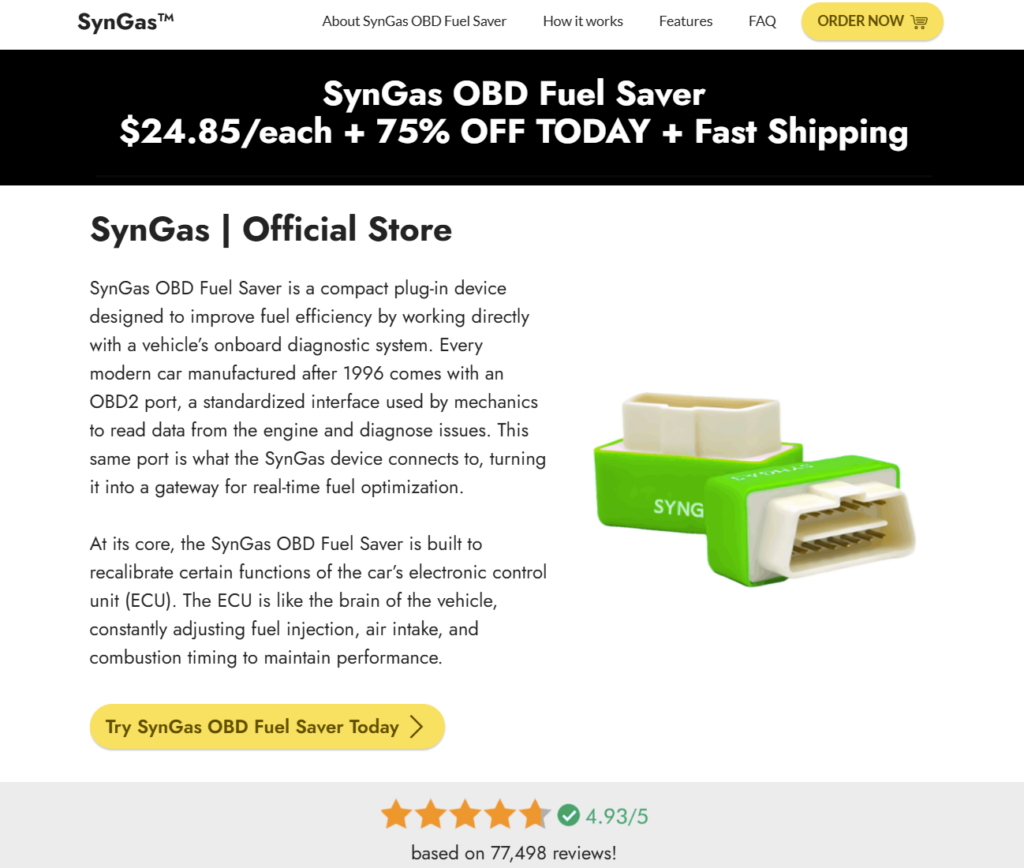
What Is SynGas Fuel Saver
The SynGas Fuel Saver is a plug-in electronic device designed for vehicles with an OBD2 diagnostic port. It is marketed as a smart fuel optimization tool that communicates with the vehicle’s onboard computer.
According to promotional materials, it claims to:
- Reduce fuel consumption
- Improve engine efficiency
- Enhance throttle response
- Optimize air-fuel ratio
- Adapt to driving behavior over time
The product positions itself as a digital performance enhancer that requires no mechanical modification.
How SynGas Fuel Saver Claims to Work
The manufacturer claims the device connects to the OBD2 system and analyzes engine data in real time. It supposedly adjusts ECU behavior to improve combustion efficiency and reduce fuel waste.
However, modern ECUs in vehicles already perform these functions automatically using:
- Closed-loop fuel injection systems
- Oxygen sensor feedback
- Adaptive ignition timing
- Driving pattern learning algorithms
This means the vehicle is already self-optimizing without external assistance.
External OBD2 devices typically have read-only or limited-access capability, which raises questions about how much control SynGas actually has over engine performance.
Technical Reality Check
Independent automotive analysis of similar OBD fuel-saving devices suggests:
- No verified engineering evidence showing meaningful ECU control
- Lack of peer-reviewed automotive testing
- No certification from recognized automotive engineering bodies
- Limited interaction between plug-in devices and core engine mapping systems
- Performance heavily dependent on driving behavior rather than technology
According to automotive engineering principles, significant fuel economy improvements usually require:
- ECU remapping or tuning software
- Mechanical engine upgrades
- Aerodynamic improvements
- Hybrid or drivetrain efficiency systems
A small plug-in device alone has very limited ability to deliver measurable fuel economy changes.
Reference context:
- Society of Automotive Engineers (SAE) research on ECU control systems highlights that modern engine management is closed-loop and self-regulating, reducing external modification impact.
- Internal combustion optimization studies consistently show diminishing returns from external signal manipulation without hardware changes.
Real User Feedback Overview
User experiences with SynGas Fuel Saver are mixed across different platforms and discussions.
Reported Positive Experiences
Some users claim:
- Slight improvement in fuel economy
- Smoother acceleration response
- More conscious driving habits
- Reduced aggressive driving behavior
Reported Negative Experiences
Other users report:
- No measurable change in fuel consumption
- Results vary widely by vehicle type
- Improvements likely due to driver awareness, not the device
- Expectations not met compared to marketing claims
This pattern is consistent with behavioral modification effects, where users naturally drive more efficiently after installing monitoring devices.
Does SynGas Fuel Saver Actually Work?
The answer depends on how performance is measured.
If “works” means:
- Significant fuel savings across most vehicles
- Verified engineering performance improvement
- Consistent results under controlled testing
Then there is no strong evidence supporting those outcomes.
If “works” means:
- Encouraging smoother driving habits
- Slight behavioral improvements in fuel usage
- Psychological awareness of consumption
Then some users may experience limited benefits.
The key distinction is between mechanical optimization and behavioral influence.
Key Limitations
The main limitations of SynGas Fuel Saver include:
- No independent laboratory verification
- No published engineering validation reports
- Limited ECU control capability in modern vehicles
- Heavy reliance on marketing-driven claims
- Performance variability across drivers and engines
- No clear technical documentation explaining algorithms
Better Alternatives for Fuel Efficiency
If the goal is real-world fuel savings, these methods are consistently more effective:
- Maintaining proper tire pressure for reduced rolling resistance
- Driving at steady speeds instead of aggressive acceleration
- Regular air filter and spark plug maintenance
- Using manufacturer-recommended engine oil grades
- Reducing unnecessary idling time
- Ensuring oxygen sensors are functioning correctly
External reference sources:
- U.S. Department of Energy fuel economy guide: https://www.fueleconomy.gov
- Society of Automotive Engineers (SAE International): https://www.sae.org
- Automotive maintenance efficiency research summaries: https://www.energy.gov
These methods are backed by automotive engineering and energy efficiency research.
Frequently Asked Questions
Is SynGas Fuel Saver a legit product?
It is a real consumer product, but there is no strong independent evidence proving its advertised fuel savings claims.
How much fuel can SynGas Fuel Saver save?
Marketing claims suggest 10 percent to 30 percent savings. However, real-world results are inconsistent and not scientifically verified.
Does SynGas Fuel Saver improve engine performance?
Modern engines already self-optimize through ECU systems. Any improvement is likely minimal or behavioral rather than mechanical.
Is SynGas Fuel Saver safe for vehicles?
It is generally safe for OBD2-equipped cars, but safety does not equal effectiveness.
Does it work on all cars?
It is compatible with most OBD2 vehicles, but compatibility does not guarantee performance improvement.
Why do some users say it works?
Reported benefits are often linked to improved driving habits and awareness rather than actual ECU control.
Do I need installation or tuning?
No installation is required. It simply plugs into the OBD2 port.
Is SynGas Fuel Saver worth buying?
Based on available technical evidence, it is not a reliable fuel-saving investment compared to standard maintenance and driving practices.
Conclusion
The SynGas Fuel Saver sits in a crowded category of OBD plug-in fuel optimization devices that promise efficiency gains without mechanical upgrades.
While the concept sounds appealing, the technical reality of modern engine control systems makes significant external optimization unlikely without deep ECU access or hardware modification.
Some users may notice slight improvements, but these are more likely tied to behavioral changes than actual engine tuning.
For consistent fuel savings, traditional maintenance and disciplined driving remain the most effective and scientifically supported approach.
Related Scam Alerts and Review
- Mary & Grace Charleston Clothing Sale Review
- Cade and Cole Asheville Clothing Sale Review
- Menty.sbs Review
- Mixwex.com Review