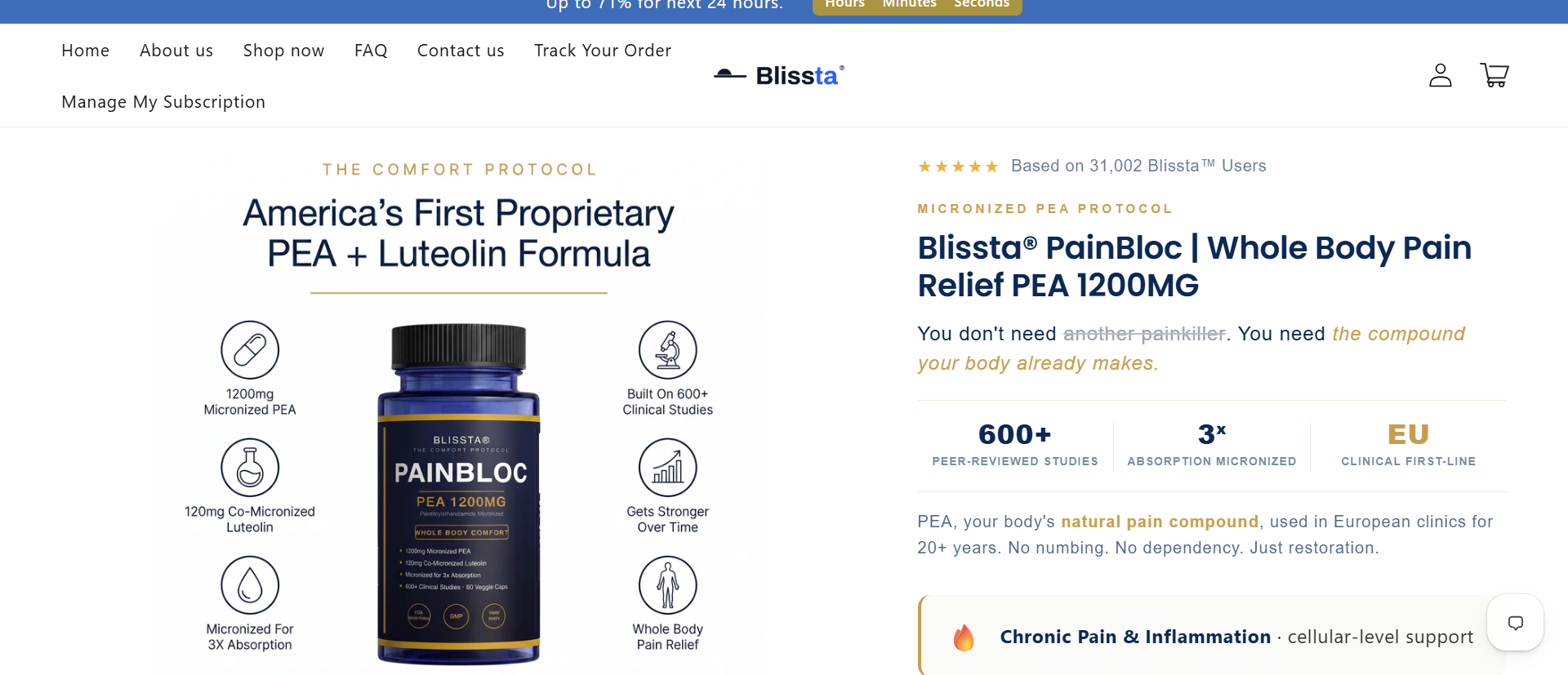
Blissta PainBloc is a dietary supplement formulated around palmitoylethanolamide (PEA), a naturally occurring compound that has attracted scientific interest for its potential role in supporting normal inflammatory and nervous-system processes.
The product also contains luteolin, a naturally occurring flavonoid that has been investigated for its antioxidant and other biological properties.
As interest in plant-based and nutritional wellness products continues to grow, consumers may come across Blissta PainBloc while researching PEA supplements. But before purchasing, it is useful to understand what the product contains, what research says about PEA, and what claims can reasonably be made based on the available evidence.
This review takes a balanced look at Blissta PainBloc PEA, including its ingredients, potential wellness benefits, scientific research, customer feedback, pricing, safety considerations, purchasing policies, and overall legitimacy.
What Is Blissta PainBloc?
Blissta PainBloc is a dietary supplement marketed around palmitoylethanolamide and luteolin.
According to the manufacturer’s product information, the formula uses a micronized form of PEA along with co-micronized luteolin. The company presents the product as part of a wellness approach focused on physical comfort and general support.
It is important to distinguish between the manufacturer’s product descriptions and independently established scientific evidence.
A dietary supplement should not be viewed as a guaranteed solution for a particular medical condition. Instead, consumers can consider whether its ingredients fit their personal wellness goals and whether the available evidence is sufficient to support their expectations.
What Is PEA?
PEA stands for palmitoylethanolamide.
It is a naturally occurring fatty-acid compound that is present in the body and has been studied for several decades.
Scientific interest in PEA has focused on its interaction with biological pathways associated with inflammation, nerve signaling, and normal cellular processes.
Researchers have conducted clinical studies investigating PEA in different areas of health and wellness. Some research has reported encouraging findings, particularly in studies involving physical discomfort.
However, results can differ depending on the formulation, amount used, duration of supplementation, and characteristics of the people participating in a study.
This means that research on PEA as an ingredient should not automatically be interpreted as proof that every PEA supplement will produce the same results.
Blissta PainBloc Ingredients:
Understanding the ingredients is an important step when evaluating any dietary supplement.
Palmitoylethanolamide
PEA is the primary ingredient associated with Blissta PainBloc.
The compound has been investigated in human studies for its potential relationship with inflammatory and pain-related processes.
Some systematic reviews have reported potentially favorable findings, although researchers have also highlighted limitations in the available evidence.
This makes PEA an interesting nutritional ingredient, but consumers should maintain realistic expectations.
Luteolin
The formula also contains luteolin.
Luteolin is a flavonoid naturally present in various plants. Researchers have investigated its antioxidant properties and its potential involvement in several cellular pathways.
Much of the research involving luteolin has been laboratory or preclinical research. Therefore, consumers should avoid assuming that findings from laboratory studies necessarily translate into specific benefits from a dietary supplement.
How Does Blissta PainBloc Work?
The manufacturer describes PEA as interacting with several biological pathways involved in normal inflammatory and cellular signaling.
One area of research involves PPAR-alpha, a receptor involved in a range of physiological processes.
Researchers have also investigated how PEA may interact with cells involved in inflammatory signaling.
These mechanisms are scientifically interesting, but understanding how an ingredient works at a biological level does not guarantee a particular outcome for an individual.
For consumers, the most useful evidence comes from well-designed human studies rather than biological explanations alone.
Potential Benefits of Blissta PainBloc:
Because PainBloc contains PEA, some of the research surrounding PEA may be relevant when considering the product.
However, these should be described as potential wellness benefits associated with the ingredient, rather than guaranteed results.
Support for Physical Comfort
PEA has been studied in connection with different forms of physical discomfort.
Some clinical research has reported improvements in pain-related measurements among participants using PEA. A 2025 meta-analysis also reported potentially positive findings across several follow-up periods.
These findings are promising but do not mean that everyone who uses a PEA supplement will experience noticeable results.
Support for Normal Inflammatory Processes
PEA has been researched for its potential role in biological processes associated with inflammation.
This is one reason it has become popular among consumers interested in nutritional approaches to general wellness.
It is important, however, not to interpret this research as evidence that PEA supplements can treat or cure an inflammatory disease.
Interest in Nerve and Cellular Health
Researchers have investigated PEA in relation to nerve-related processes and cellular signaling.
This scientific interest has contributed to the popularity of PEA among people researching nutritional wellness products.
Again, research findings should be considered evidence about the ingredient rather than a guarantee about a specific commercial product.
What Does Scientific Research Say About PEA?
PEA has been examined in numerous scientific studies, including clinical trials and systematic reviews.
A systematic review and meta-analysis published in Pain evaluated randomized controlled trials involving PEA and reported evidence of potential pain reduction, while also noting limitations in the available research. (PubMed)
A later 2025 meta-analysis involving 18 studies and 1,196 participants also reported statistically significant improvements in pain-related outcomes at several follow-up points. The researchers described PEA as a potentially useful option for further investigation while noting the need for additional high-quality research. (PubMed)
This is encouraging, but it is important to maintain perspective.
Scientific evidence does not mean that:
- PEA works identically for everyone
- Every PEA formulation is equivalent
- Every health claim made by a supplement company is proven
- A supplement can replace professional healthcare
The most reasonable conclusion is that PEA is a scientifically researched ingredient with promising areas of investigation, but more research can help clarify its potential uses.
Blissta PainBloc Customer Reviews
Customer reviews can offer useful information about people’s experiences with a product, but they should be interpreted as anecdotal feedback.
The manufacturer’s website features customer testimonials discussing experiences involving physical comfort, mobility, sleep, and general satisfaction.
These comments may be useful for understanding why some customers choose the product. However, individual testimonials cannot establish that the product will provide the same experience for everyone.
Several factors can influence a person’s experience with a supplement, including lifestyle, diet, expectations, other products being used, and individual differences.
Positive Customer Feedback
Customer testimonials featured on the manufacturer’s website generally describe experiences such as:
- Greater feelings of comfort
- Improved mobility
- Positive impressions of the product
- Satisfaction with continued use
- General wellness support
These are personal experiences rather than independently verified clinical outcomes.
Why Customer Reviews Should Be Viewed Carefully
A positive review can tell readers what one customer experienced, but it cannot establish cause and effect.
Likewise, a customer who notices little difference does not necessarily prove that a product has no value.
For this reason, customer feedback is best considered alongside ingredient information and independent scientific research.
Blissta PainBloc Price
Product prices can change because of promotions, package sizes, subscriptions, and other purchasing options.
Consumers should check the current price directly from the seller before ordering.
Rather than considering the bottle price alone, it may be useful to calculate the cost per serving.
Before purchasing, check:
- Current product price
- Number of capsules
- Number of servings
- Cost per serving
- Shipping fees
- Promotional conditions
- Subscription pricing
- Cancellation terms
This can help consumers understand the actual cost of using the product over time.
Shipping and Delivery
Shipping times can vary depending on the seller, location, carrier, and selected delivery option.
Before ordering, review the current shipping information and check whether tracking is available.
It is also a good idea to keep the order confirmation and tracking details until the package has been delivered.
Returns and Refunds
Consumers should always review a supplement company’s return and refund policy before completing an online purchase.
Check the current policy for:
- Length of the refund period
- Eligibility requirements
- Whether opened products can be returned
- Return shipping arrangements
- Refund processing times
- Subscription cancellation requirements
Because company policies can change, the terms displayed at the time of purchase should be considered the most relevant.
Is Blissta PainBloc Legit?
Blissta PainBloc is presented as a commercially available dietary supplement from an identifiable seller.
The manufacturer’s website provides product information, ingredient details, customer-support information, and purchasing options.
However, legitimacy and effectiveness are separate issues.
A supplement can be sold by a legitimate business without every marketing statement being clinically established.
Consumers should therefore look beyond the appearance of a website and evaluate:
- Ingredient transparency
- Manufacturer information
- Customer support
- Product labeling
- Pricing
- Refund policies
- Scientific evidence
- Marketing language
A transparent purchasing experience can help consumers make a more informed decision.
Is Blissta PainBloc a Scam?
There is insufficient evidence to describe Blissta PainBloc as a scam.
The product is openly marketed and the primary ingredient, PEA, is a genuine compound that has been investigated in scientific research.
At the same time, consumers should be cautious about interpreting promotional language as medical evidence.
A sensible approach is to view PainBloc as a nutritional supplement and evaluate its ingredients and available research without expecting guaranteed outcomes.
Blissta PainBloc Safety
Safety is an important consideration with every dietary supplement.
PEA has been used in clinical research, and available studies have generally reported favorable tolerability. However, individual circumstances can differ.
The FDA advises consumers to discuss dietary supplements with healthcare professionals when appropriate because supplements can interact with medicines and may not be suitable for everyone. (FDA)
Anyone taking medication, managing an ongoing health condition, or experiencing persistent or unexplained symptoms should consider obtaining appropriate professional advice before starting a new supplement.
Is Blissta PainBloc FDA Approved?
Blissta PainBloc is marketed as a dietary supplement.
The FDA explains that dietary supplements are not generally approved for safety and effectiveness before reaching the market in the same way prescription medicines are. Manufacturers are responsible for complying with applicable requirements. (FDA)
This distinction is important when reading supplement advertisements.
Consumers should not assume that a product has been individually approved by the FDA simply because it is sold in the United States.
Blissta PainBloc Pros and Cons:
Pros
- Contains PEA, an ingredient studied in human research
- Uses a micronized PEA formulation
- Includes luteolin
- Available product information from the manufacturer
- PEA has been investigated in multiple clinical studies
- Convenient supplement format
- Can be considered as part of a broader wellness routine
Cons
- Product-specific clinical evidence may be limited
- Research results can vary between formulations
- Individual experiences may differ
- Customer testimonials are not clinical evidence
- Marketing claims should be evaluated carefully
- Prices and policies can change
- Supplements are not substitutes for appropriate professional healthcare
Things to Consider Before Buying Blissta PainBloc:
Check the Current Label
Review the Supplement Facts panel and confirm the amount of PEA, luteolin, and any other ingredients.
Research the Ingredient
Look at independent scientific sources rather than relying exclusively on promotional content.
Consider Your Personal Circumstances
A supplement may not be appropriate for everyone. Consider medications, existing health concerns, allergies, and other supplements you may already use.
Review the Total Cost
Check the cost per serving and determine whether a subscription is involved.
Read the Refund Policy
Understand the current return and refund requirements before completing your purchase.
Maintain Realistic Expectations
No dietary supplement can guarantee identical results for every individual.
Blissta PainBloc vs. Other PEA Supplements:
If you are comparing PainBloc with other PEA products, consider objective factors rather than marketing claims.
Useful comparison points include:
| Factor | What to Look For |
|---|---|
| PEA amount | Amount provided per serving |
| PEA formulation | Micronized or other form |
| Additional ingredients | Luteolin or other compounds |
| Label transparency | Clearly disclosed ingredients |
| Quality information | Testing and manufacturing information |
| Price | Cost per serving |
| Company information | Clear contact and manufacturer details |
| Refund policy | Clear terms and conditions |
| Subscription | Transparent recurring-billing information |
The most expensive product is not automatically the most effective, and the least expensive option is not necessarily the best value.
Final Verdict: Is Blissta PainBloc Worth Considering?
Blissta PainBloc is a PEA-based dietary supplement that may appeal to consumers interested in nutritional approaches to physical comfort and general wellness.
Its main ingredient, palmitoylethanolamide, has been investigated in clinical research, including systematic reviews and meta-analyses. Some studies have reported encouraging findings involving pain-related outcomes.
However, these findings should be interpreted carefully.
Research on PEA does not automatically establish that Blissta PainBloc will produce a particular result, and individual experiences with dietary supplements can vary.
For consumers considering PainBloc, the most responsible approach is to examine the current ingredient label, research PEA independently, understand the cost and purchasing terms, and consider professional guidance when appropriate.
Overall, Blissta PainBloc appears to be a commercially available PEA supplement with a scientifically researched primary ingredient, but consumers should approach it as a wellness product rather than a guaranteed solution for a health condition.
Frequently Asked Questions:
What is Blissta PainBloc?
Blissta PainBloc is a dietary supplement formulated around palmitoylethanolamide (PEA) and luteolin.
What is PEA?
PEA, or palmitoylethanolamide, is a naturally occurring compound that has been studied for its potential relationship with inflammatory, nerve, and pain-related processes.
What are the potential benefits of PEA?
Research has investigated PEA in connection with physical comfort and inflammatory processes. Some clinical studies have reported encouraging findings, although further research is still useful.
Does Blissta PainBloc really work?
Research involving PEA is promising in some areas, but this does not guarantee that every person will experience the same results from PainBloc.
Is Blissta PainBloc safe?
PEA has been studied in humans, but individual suitability varies. People taking medication or managing an ongoing health concern should consider discussing supplement use with a healthcare professional.
Is Blissta PainBloc FDA approved?
Dietary supplements are not generally subject to the same premarket FDA approval process as prescription medicines. The FDA provides additional information about how dietary supplements are regulated. (FDA)
Is Blissta PainBloc a scam?
There is insufficient evidence to label PainBloc a scam. Consumers should nevertheless evaluate the product’s ingredients, seller information, pricing, policies, and scientific evidence before purchasing.
Are Blissta PainBloc reviews reliable?
Customer reviews can provide insight into individual experiences, but they should not be treated as clinical evidence. Independent research is more useful when assessing potential health effects.
Conclusion:
Blissta PainBloc is a dietary supplement centered on palmitoylethanolamide, an ingredient that has received considerable scientific interest.
Research into PEA has produced some encouraging findings, particularly in studies examining physical comfort and pain-related outcomes. However, the evidence is not a reason to expect guaranteed results from a particular supplement.
Consumers researching Blissta PainBloc PEA reviews should look beyond testimonials and promotional claims. Reviewing the ingredient label, researching the science, checking the current price, understanding purchasing policies, and considering individual circumstances can all contribute to a more informed decision.
PainBloc may be of interest to people exploring PEA supplements as part of a broader wellness routine. However, it should not be presented as a substitute for professional healthcare or as a guaranteed treatment for a medical condition.
Read our complete product reviews here to know more about scam products.
Disclaimer:
This article is intended for general informational and educational purposes only. It is not medical advice and does not diagnose, treat, cure, or prevent any disease or medical condition.
Dietary supplements can affect individuals differently and may interact with medications or other supplements. If you have questions about whether a supplement is appropriate for you, consult an appropriately qualified healthcare professional.
Product formulations, prices, shipping information, refund policies, and other details may change. Readers should verify current information directly with the manufacturer before making a purchase.
Relevant Sources and Further Reading:
Scientific Research on PEA
PubMed: Palmitoylethanolamide in Chronic Pain
PubMed: Palmitoylethanolamide and Pain – 2025 Meta-Analysis
PubMed: Micronized PEA in Chronic Pain
PubMed: Efficacy of Palmitoylethanolamide for Pain
Supplement Safety and Regulation
FDA: FDA 101 – Dietary Supplements
FDA: Information for Consumers on Using Dietary Supplements
These sources provide additional background on PEA research and the regulatory framework surrounding dietary supplements.