Introduction
Food safety is now a major concern in modern households due to pesticide use, wax coatings, and microbial contamination on fresh produce. Devices like the PuriBreeze Produce Cleaner claim to solve this problem using electrolysis based water cleaning technology.
The product promises a simple workflow. Place fruits and vegetables in water, activate the device, and let it remove contaminants automatically.
The real question is whether this technology offers measurable improvement over traditional washing methods or whether it is primarily a convenience driven gadget.
This review provides a balanced, evidence informed breakdown.
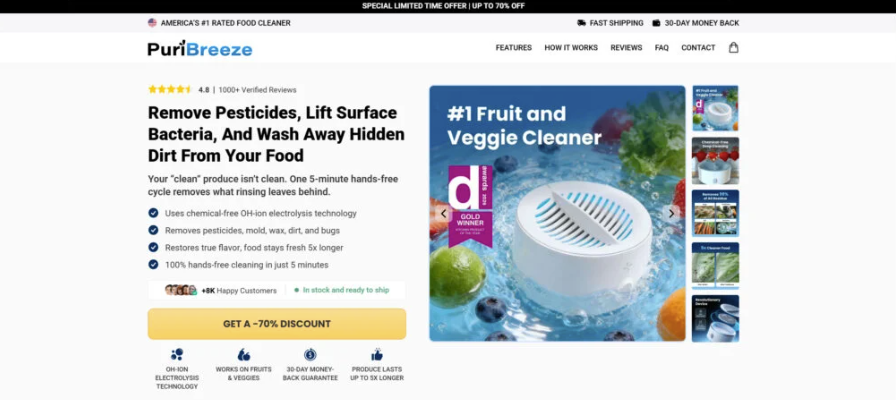
What Is PuriBreeze Produce Cleaner?
PuriBreeze is a countertop device that uses OH ion electrolysis to clean fruits and vegetables in water.
It claims to:
- Reduce pesticide residues
- Break down wax coatings
- Remove bacteria and surface contaminants
- Improve freshness and hygiene
The device is marketed as a hands-free alternative to scrubbing and rinsing.
How the Technology Works
The system relies on electrolysis, where an electric current is passed through water to generate reactive oxygen species and microbubbles.
Scientific background shows that electrolyzed water can reduce microbial load under controlled conditions in food safety applications. Research on electrolyzed water in food sanitation supports antimicrobial potential in industrial settings according to studies indexed on https://arxiv.org/abs/2002.05965
However, performance depends heavily on concentration, exposure time, and system calibration. Industrial systems are tightly controlled, while consumer devices like PuriBreeze are not standardized or independently regulated at the same level.
This creates a gap between theoretical science and real-world consumer performance.
Real World Performance and User Experience
What users report
- Water becomes visibly cloudy during use
- Simple one button operation
- Perceived improvement in cleanliness
- Convenience compared to manual washing
The cloudy water effect is often interpreted as evidence of deep cleaning, but it mainly reflects surface debris being released into water rather than confirmed pesticide removal.
Independent Analysis and Market Concerns
Several independent product reviews highlight concerns about marketing practices and lack of verified testing.
Analyses suggest:
- Heavy reliance on promotional content rather than lab verified performance data
- Limited transparent third party testing
- Affiliate driven review ecosystems influencing perception
For example, consumer safety analysis platforms discuss similar electrolysis produce cleaners and caution about exaggerated claims https://myantispyware.com/2026/04/16/puriproduce-reviews-electrolysis-microbubble-trick-scam-exposed
Additional breakdowns also point to inconsistent verification of effectiveness claims https://derealestreviews.com/puribreeze-cleaner-reviews-2026
These sources highlight the importance of separating marketing language from scientifically validated performance.
Key Concerns and Limitations
Exaggerated marketing claims
Claims of near total pesticide removal or dramatically extended freshness are not consistently supported by independent scientific studies.
Lack of standardized testing
There is no widely recognized clinical or agricultural testing confirming superiority over conventional washing methods.
Variable user outcomes
Performance appears inconsistent depending on usage conditions and produce type.
Device longevity concerns
Some reports on similar electrolysis-based cleaners mention performance decline over time due to electrode wear and mineral buildup https://muaphysicians.com/puri-produce-reviews-and-complaints
Comparison With Traditional Washing Methods
Running water with friction
- Removes dirt, dust, and surface contaminants effectively
- Recommended by food safety authorities such as the U.S. Food and Drug Administration https://www.fda.gov/food/buy-store-serve-safe-food/washing-food
Baking soda soak
- Some studies suggest it may reduce pesticide residues more effectively than water alone in certain cases
- Low cost and widely accessible method
Vinegar rinse
- Can reduce some surface microbes
- Not a complete sterilization method
PuriBreeze device
- Adds convenience and automation
- Provides visual reassurance through cloudy water effect
- Lacks strong independent proof of superior cleaning performance
Is PuriBreeze Worth It?
It may be useful if you want
- A convenience based cleaning routine
- A gadget driven kitchen experience
- Psychological reassurance about produce cleanliness
It may not be suitable if you expect
- Verified pesticide elimination superiority
- Strong peer reviewed scientific validation
- Better cost to performance ratio than traditional methods
Safety Perspective
Electrolysis based cleaning devices are generally considered low risk when used correctly. However, safety does not automatically translate to superior effectiveness.
Safe usage does not equal scientifically proven performance advantage.
Better Evidence Based Alternatives
Running water with friction
Still the most widely recommended and practical method for daily produce cleaning https://www.fda.gov/food/buy-store-serve-safe-food/washing-food
Baking soda solution
A low cost method with some research support for reducing certain pesticide residues
Vinegar rinse
Useful for reducing surface bacteria, though not a full disinfection method
Final Verdict
PuriBreeze Produce Cleaner sits in the category of modern wellness gadgets that combine real electrolysis science with strong consumer marketing.
The underlying principle is scientifically valid, but the consumer application lacks strong independent validation showing clear superiority over traditional washing methods.
In practical terms, it is more of a convenience and reassurance tool than a necessity for food safety.
Frequently Asked Questions
What is PuriBreeze Produce Cleaner used for?
It is designed to clean fruits and vegetables using electrolysis technology that claims to remove pesticides, wax, and surface contaminants.
Does PuriBreeze actually remove pesticides?
It may reduce some surface residues, but there is no strong independent scientific evidence confirming it performs better than traditional washing methods.
Is PuriBreeze better than washing with water?
Not clearly. Running water with friction remains highly effective and is recommended by food safety authorities for everyday produce cleaning.
Is PuriBreeze scientifically proven?
The electrolysis concept is scientifically valid, but the device itself lacks strong peer reviewed studies confirming superior performance in real world home use.
Is it safe to use?
Yes. It uses low voltage electrolysis in water and is generally considered safe when used according to instructions.
Why does the water look dirty after use?
Cloudy water is usually caused by loosened surface dirt, wax, or organic debris. It does not automatically indicate pesticide removal.
Can it kill bacteria on fruits and vegetables?
It may reduce some surface bacteria, but it should not be considered a full sterilization method.
Is PuriBreeze worth buying?
It depends on expectations. It is more valuable for convenience and reassurance than for proven scientific superiority.
What is the best alternative to PuriBreeze?
Running water with friction and baking soda soak remain the most practical and evidence supported methods for household use.
Conclusion
PuriBreeze Produce Cleaner reflects a broader trend in consumer wellness technology where scientific concepts are adapted into convenience focused devices.
While electrolysis has real scientific grounding, current evidence does not strongly support it as a superior replacement for traditional washing methods.
For most households, proven low cost cleaning methods remain effective, reliable, and practical without additional gadget investment.
Related Scam Alerts and Review
- Moonset Starry Sky Night Light Projector Review 2026
- 833-418-6291 Reviews
- Celestvéra Microneedle Tanning Patch Review 2026